Choosing the right Insulated Panels can influence energy use, installation speed, hygiene, and long-term building performance. Global buyers often compare more than thermal values. They examine core materials, fire behavior, surface finishes, joint design, supplier experience, and regional compliance requirements. A panel that performs well in a cold warehouse may not suit a humid coastal factory.
This guide explores ten common panel types used in commercial, industrial, agricultural, and temperature-controlled projects. Options may include EPS, PIR, polyurethane, mineral wool, rock wool, sandwich, cleanroom, cold room, roof, and acoustic panels. Each type has practical strengths and limitations. For example, a PIR panel can offer strong thermal efficiency, while mineral wool may provide better fire resistance. Details matter. A poorly sealed joint can reduce real-world performance, even when laboratory figures look impressive.
Real projects are rarely tidy. Site access, uneven steel frames, skilled labor, condensation risks, and replacement needs can change the final decision. Buyers should request technical datasheets, tested fire classifications, warranty terms, sample sections, and references from comparable installations. Standards differ between markets, so independent verification remains important. Supplier claims deserve careful review. This overview is designed to support informed discussions with manufacturers, engineers, contractors, and compliance specialists. It does not replace project-specific calculations or professional advice. The best choice is rarely the cheapest panel. It is the panel that fits the building, climate, budget, and expected service life.
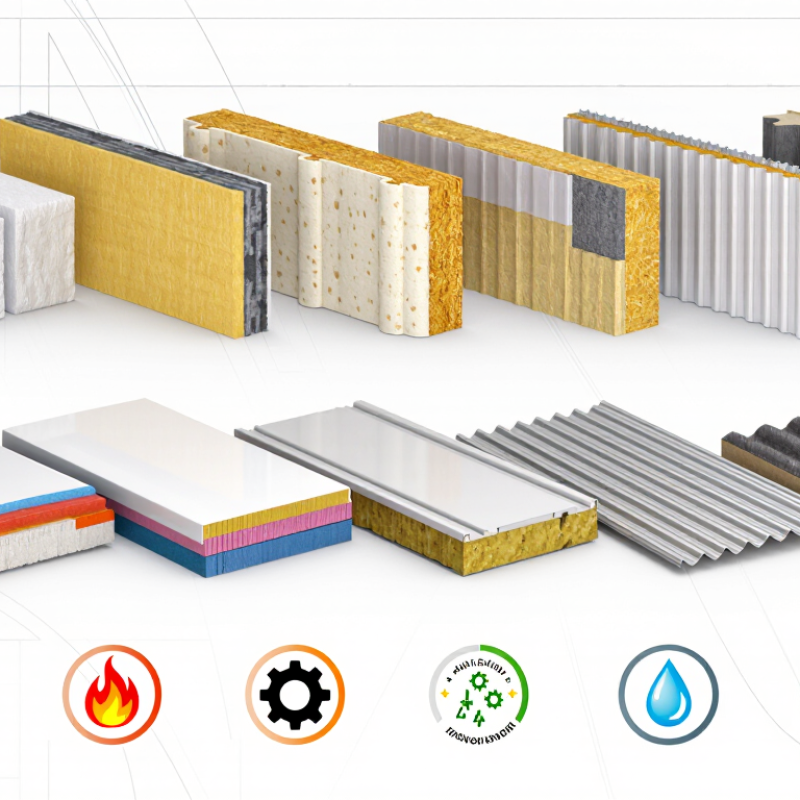
Top 10 Types of Insulated Panels for Global Buyers
Insulated Panel Basics: Structure, Materials, and Core Performance
An insulated panel combines two protective facings with a lightweight thermal core. Steel facings add strength, while aluminum suits corrosion-sensitive environments. Common cores include EPS, PIR, mineral wool, phenolic foam, and XPS. Each changes weight, fire behavior, moisture resistance, and cost.
The core affects more than insulation. The Global Status Report for Buildings and Construction 2023 reported that buildings used about 34% of global energy and produced nearly 37% of energy-related emissions. Better panels can reduce heating and cooling demand, but installation quality remains critical. A low U-value is not the whole answer. Joints, fasteners, damaged edges, and thermal bridges can weaken real performance. On active projects, small gaps around doors often become visible through condensation or cold surfaces. This is easy to underestimate. Fire resistance also requires tested assemblies, not simply a preferred core material. Standards such as ISO 6946 help calculate thermal resistance, while EN 14509 supports performance assessment for factory-made sandwich panels.
Tips: Compare declared U-values under the same conditions. Check fire classification, vapor control, joint design, and tested spans. Ask for independent test reports and temperature-range data. Reconsider recycled content claims when moisture or durability evidence is missing. A cheaper panel may demand thicker insulation, stronger supports, or earlier replacement.
Insulated Panel Basics: Structure, Materials, and Core Performance
Indicative material values compiled from commonly published technical ranges for insulation materials. Values are not brand-specific product ratings.
Insulated panels differ by construction, core material, and site demands. EPS-core sandwich panels offer low cost and simple installation. XPS-core panels resist moisture better, making them suitable for cold rooms and damp foundations. PUR-core panels provide strong thermal performance with relatively thin profiles. PIR-core panels improve fire performance, but local certification still matters. Mineral wool-core panels add non-combustible protection and effective acoustic control.
Glass wool-core panels remain lightweight and useful for roofs, walls, and interior partitions. Phenolic foam panels deliver low thermal conductivity, although their surface can be more fragile during handling.
Structural insulated panels combine oriented board skins with a rigid foam core. They support rapid building assembly, but joint accuracy is critical. Insulated metal panels use coated steel or aluminum skins around several possible cores. Their durability depends heavily on fasteners, seals, and drainage details.
Cement particle-faced composite panels tolerate impact and provide a solid finishing surface. Aluminum honeycomb panels are light, rigid, and often selected for architectural envelopes. Vacuum insulated panels achieve exceptional insulation in narrow spaces, but punctures can sharply reduce performance. Field inspections often reveal damaged edges, compressed seals, or poorly aligned joints. Those small defects can undermine an expensive core material. A thicker panel is not always better. Designers should compare climate, fire rating, moisture exposure, span, repair access, and installer skill before approval. Some specifications look complete, yet omit thermal bridging at corners.
Top 10 Types of Insulated Panels for Global Buyers
Industrial projects demand panels that manage heat, moisture, fire, and mechanical stress. Common choices include PIR, PUR, EPS, XPS, mineral wool, glass wool, phenolic foam, and insulated metal panels. Cold-room panels and structural insulated panels also serve specialized facilities. Factories often use mineral wool near high-temperature zones, while PIR panels support lighter roofs and walls. Cold storage requires tight joints, sealed penetrations, and stable low-temperature performance. Small installation errors can create large energy losses.
Commercial buildings need balanced thermal performance, appearance, acoustic control, and construction speed. Insulated metal panels suit warehouses, retail units, and logistics centers with large wall areas. Phenolic and PIR cores can reduce wall thickness where floor space matters. The International Energy Agency reports that buildings consume about 30% of global final energy. The 2023 UNEP Global Status Report also links buildings to approximately 37% of global energy-related and process emissions. These figures make envelope quality a practical business issue, not just a design preference. Yet, selecting the thinnest panel is not always wise.
Residential projects usually favor EPS, XPS, mineral wool, and structural insulated panels. They support external walls, roofs, extensions, and modular housing. Fire performance, indoor comfort, local climate, and installer skill should guide selection. Testing under standards such as EN 14509, ASTM C518, or equivalent local requirements improves comparison reliability. Reports cannot replace site judgment. Details decide. A panel may perform poorly when moisture control, fasteners, or junction design receive little attention.
| No. | Panel Type | Typical Insulation Core | Typical Thermal Conductivity (λ, W/m·K) |
Common Thickness Range | Fire and Moisture Considerations | Key Applications |
|---|---|---|---|---|---|---|
| 1 | PIR Insulated Sandwich Panels | Polyisocyanurate rigid foam between metal, cement-based, or composite facings | Approximately 0.022–0.028 | 40–200 mm | Good thermal efficiency; fire behavior depends on formulation, facings, joints, and tested assembly. Closed-cell structure provides low water absorption. | Industrial buildings Cold rooms Warehouses Commercial roofs and walls |
| 2 | PUR Insulated Sandwich Panels | Polyurethane rigid foam with metal or composite facings | Approximately 0.022–0.028 | 40–200 mm | High insulation value per unit thickness and low water absorption. Combustible polymer core; fire classification must be verified for the complete panel system. | Refrigerated storage Food-processing areas Industrial walls Modular buildings |
| 3 | Mineral Wool Sandwich Panels | Stone wool or glass wool fibers between metal facings | Approximately 0.034–0.040 | 50–250 mm | Non-combustible mineral fiber can provide strong fire resistance when tested as a system. Moisture performance depends on facing integrity, density, and joint detailing. | Factories High-rise commercial buildings Fire-rated partitions Industrial enclosures |
| 4 | EPS Sandwich Panels | Expanded polystyrene foam with metal, cement board, or other facings | Approximately 0.034–0.040 | 40–200 mm | Cost-effective and lightweight, but the polymer core is combustible. Water absorption and vapor control depend on the facing and edge-joint design. | Agricultural buildings Low-rise commercial projects Temporary structures Residential extensions |
| 5 | XPS Insulated Panels | Extruded polystyrene rigid foam, usually faced with membranes, boards, or protective layers | Approximately 0.029–0.036 | 20–200 mm | Low water absorption and high compressive strength make it suitable for damp or below-grade conditions. Combustible core requires appropriate fire protection. | Foundation insulation Inverted roofs Cold floors Basements |
| 6 | Phenolic Foam Panels | Rigid phenolic resin foam with foil, fiberglass, or other facings | Approximately 0.018–0.023 | 20–150 mm | Very low thermal conductivity enables thinner assemblies. Fire, smoke, and surface-finish performance vary by product and must be confirmed through testing. | Space-constrained walls Commercial roofs HVAC insulation High-performance retrofits |
| 7 | Structural Insulated Panels (SIPs) | EPS, XPS, or polyurethane foam core bonded between oriented strand board or structural facings | Approximately 0.022–0.040, depending on core | 100–300 mm | Provides insulation and structural capacity as a prefabricated system. Moisture control, fire protection, ventilation, and joint sealing are essential to performance. | Residential walls Roofs and floors Prefab housing Low-rise commercial buildings |
| 8 | Vacuum Insulated Panels (VIPs) | Microporous silica, fiberglass, or similar core enclosed in a gas-tight barrier envelope | Approximately 0.002–0.008 when new and intact | 10–50 mm | Extremely high insulation value in thin sections. Performance is sensitive to puncture, edge damage, aging, and installation tolerances; panels generally cannot be cut on site. | Ultra-thin retrofits Refrigeration equipment 冷链设备 High-performance façades |
| 9 | Wood-Fiber Insulated Panels | High-density or flexible wood fibers, sometimes combined with structural wood facings | Approximately 0.038–0.050 | 40–240 mm | Can provide vapor-open construction and useful heat capacity. Moisture protection, detailing, and fire treatment depend on density and product design. | Residential envelopes Timber buildings Roof underlays Renovation projects |
| 10 | Aerogel-Enhanced Insulated Panels | Silica aerogel composite, often combined with fiber reinforcement or rigid facing boards | Approximately 0.013–0.020 | 10–80 mm | Very low conductivity and strong performance where space is limited. Product-specific fire, vapor, compression, and installation data should be reviewed before specification. | Historic building upgrades Thin façade systems Industrial equipment High-performance retrofits |
Note: Values are representative ranges for commonly available panel products. Actual thermal resistance, fire classification, moisture behavior, structural capacity, and service life depend on the complete tested assembly, facing materials, joints, climate, and local building regulations.
Top 10 Types of Insulated Panels for Global Buyers
Global Buyer Criteria: Thermal, Fire, Acoustic, and Moisture Performance
Choosing insulated panels starts with the building’s actual climate and use. Common options include EPS, XPS, PUR, PIR, mineral wool, glass wool, phenolic foam, cement-faced panels, cleanroom panels, and vacuum insulated panels. Each type balances thermal resistance, fire behavior, sound control, and moisture tolerance differently. A cold-storage wall may need low heat transfer and vapor resistance. A school or factory may value acoustic absorption more than maximum insulation thickness. Data sheets matter, but site conditions matter more.
Fire performance requires careful verification. Check the full wall assembly, not only the core material. Joints, fasteners, sealants, and penetrations can change the result. Mineral wool often supports strong fire resistance, while some foam cores offer higher thermal efficiency with thinner profiles. Local codes and tested classifications should guide the specification. Ask for independent test reports and installation instructions. Marketing language is not evidence.
Moisture deserves equal attention. Condensation can form around cold bridges, damaged coatings, or poorly sealed edges. During inspections, look for wet insulation, loose joints, and trapped water near door openings. Acoustic performance also depends on density, panel connections, and the surrounding structure. No panel solves every problem. A thinner panel may save space but increase installation risk. That trade-off is easy to underestimate. Qualified engineers should review climate data, fire requirements, hygiene needs, and maintenance access before purchase.
Global buyers often compare ten insulated panel choices: EPS, XPS, PUR, PIR, phenolic foam, mineral wool, fiberglass, vacuum insulated, structural insulated, and cleanroom panels. The categories are not perfectly equal. Some describe core materials, while others describe complete systems. PIR and PUR provide strong thermal performance with thinner cores. Mineral wool offers better fire resistance and acoustic control. EPS often reduces purchase cost, but its insulation value and fire classification require close review.
Standards should match the project location, not simply follow a supplier brochure. EN 14509, ASTM C1289, fire-test reports, thermal conductivity data, and hygiene requirements may all apply. Request batch traceability, declared U-values, dimensional tolerances, warranties, and installation drawings. The lowest quote may not be the lowest installed cost. Freight volume, customs, cutting waste, fasteners, vapor control, and labor can change the final budget. Compare suppliers using the same core thickness, facing material, fire rating, and delivery terms. A local source may offer faster support, while an overseas supplier may offer wider customization. Both can disappoint without quality records.
Tips: Confirm substrate flatness before delivery. Keep panels dry and shaded. Seal joints continuously, especially around doors and penetrations. Use compatible flashings and approved fixings. Cold rooms need correct vapor direction, not only thicker insulation. Roof panels require safe access, proper lap direction, and drainage planning. Document fastening torque, joint width, and damaged edges. One overlooked screw can create a thermal bridge. Installation teams sometimes rush this stage. Performance then declines quietly.
It usually has two protective facings and a lightweight thermal core. Steel adds strength, while aluminum suits corrosion-sensitive areas. Common cores include EPS, PIR, PUR, mineral wool, phenolic foam, XPS, and glass wool.
The core influences thermal insulation, weight, fire behavior, moisture resistance, sound control, and cost. Mineral wool offers non-combustible protection. XPS handles moisture well. Phenolic foam provides low thermal conductivity but may have fragile surfaces.
No. Joints, fasteners, corners, damaged edges, and thermal bridges can reduce real performance. A small gap near a door may create condensation or a cold surface. Details decide.
XPS-core panels resist moisture and can suit cold rooms or damp foundations. Cold storage also needs sealed joints and penetrations. Stable low-temperature performance matters. A strong core cannot fix careless installation.
Mineral wool panels offer non-combustible protection in suitable tested assemblies. PIR panels may provide improved fire performance. The complete assembly still requires local testing and certification. Material names alone are not enough.
Not always. A thicker panel may need stronger supports and create more difficult junction details. Compare climate, span, fire rating, moisture exposure, repair access, and installer skill. More thickness can hide design problems.
Check declared U-values under identical conditions. Review fire classification, vapor control, joint design, tested spans, and temperature-range data. Inspect seals, fasteners, drainage, and panel edges. Small defects become expensive.
Residential projects often use EPS, XPS, mineral wool, or structural insulated panels. These can serve walls, roofs, extensions, and modular housing. Indoor comfort and local climate should guide selection. I would not trust a generic specification alone.
Insulated Panels are engineered building components made from a protective outer skin and an insulating core, combining structural support with thermal control. This article introduces ten major panel types classified by construction method and core material, including options designed for different levels of insulation, fire resistance, acoustic performance, moisture protection, and durability. It explains how panel composition affects energy efficiency, service life, handling, and suitability for demanding environments.
The discussion also examines applications in industrial facilities, commercial buildings, warehouses, cold storage areas, agricultural structures, and residential projects. For global buyers, selecting the right product requires comparing thermal ratings, fire classifications, sound-control properties, moisture resistance, relevant regional standards, total cost, supplier capability, and installation requirements. By evaluating both technical performance and project conditions, buyers can choose panels that support reliable construction, lower operating needs, and long-term value across diverse climates and building uses.

JUTAO NEW MATERIAL